
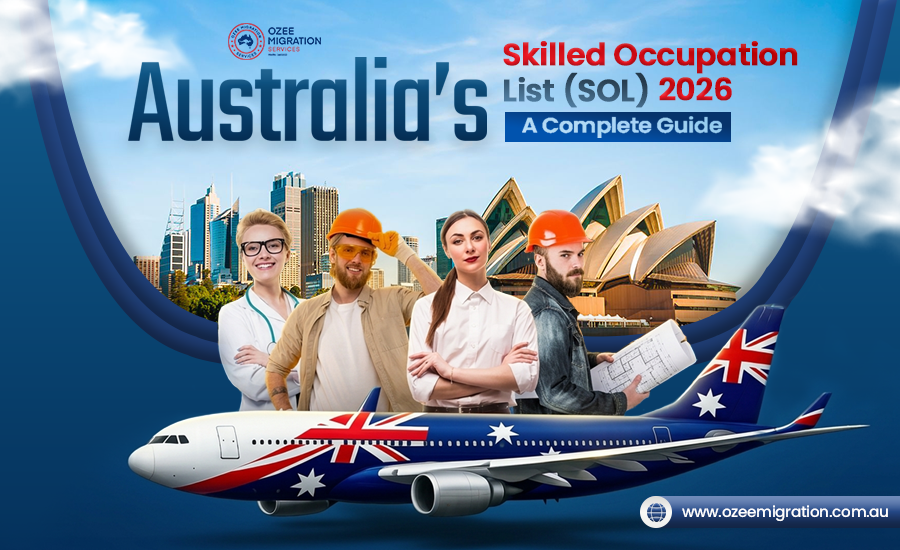
For any skilled professional looking to migrate and work in Australia, career opportunities are endless, and the quality of life is just what most dream of. Besides, the Australian government has created several pathways to permanent residency for skilled professionals who can add value to the country’s economic growth.
Indeed, all of this makes Australian migration worthwhile. However, before setting out on the journey to move to Australia in 2026 as a skilled professional, the most basic thing to check is if the occupation is on the Skilled Occupation List (SOL).
Read this guide to know what exactly the SOL is and how it works to determine eligibility for Australian migration and PR in 2026.
What is Australia’s Skilled Occupation List (SOL)?
So, basically, the Skilled Occupation List (SOL) is the official list published by the Australian Government to identify and highlight professions experiencing labour shortages in the country. This list helps Australia fill workforce gaps in various industries by accepting skilled immigrants where local workers are not readily available.
Hence, the Department of Home Affairs uses these occupation lists to determine eligibility for various skilled migration and employer-sponsored visa programs, including permanent residency.
The professions on the lists are classified according to the Australian and New Zealand Standard Classification of Occupations (ANZSCO). It outlines the duties, skill levels, and qualification requirements for each profession.
To make it simpler for you, if your occupation is listed on the SOL, you may qualify to migrate to Australia through a skilled visa program. On the flipside, if your profession is not listed, your migration options clearly may narrow down.
What Makes the Skilled Occupation List Important?
Whether you are an engineer, nurse, IT professional, teacher, accountant, or skilled tradesperson, the Skilled Occupation List (SOL) can help in figuring out your eligibility for Australian migration. Not only that, it actually guides you to know what visa subclasses you can apply for, as well as your genuine chances of receiving state nomination based on your profession. Plus, the Department also takes into consideration the Skilled Occupation List when evaluating the application for permanent residency.
Thus, from the moment you plan to move to Australia to all the way to the point of securing permanent residency, this list will have a huge impact on whether you qualify for migration and long-term settlement. So, checking whether your occupation is on the list should be your first step before even thinking of planning an Australian migration.
Key Skilled Occupation Lists in 2026
So, here is the thing: this Skilled Occupation List (SOL) is not some lengthy document. For better clarity, it is classified into different occupation categories, as explained below:
Medium and Long-Term Strategic Skills List (MLTSSL)
The MLTSSL covers all occupations deemed to be essential to Australia’s long-term economic development. This is by far the most helpful list for applicants, as it opens access to multiple visa pathways, such as the following:
- Skilled Independent Visa (Subclass 189)
- Skilled Nominated Visa (Subclass 190)
- Skilled Work Regional Visa (Subclass 491)
MLTSSL-listed professions not only present more visa opportunities but also stronger PR prospects. It typically includes roles such as software engineer, registered nurse, civil engineer, electrician, medical practitioner, secondary school teacher, and others.
Short-Term Skilled Occupation List (STSOL)
The STSOL basically comprises a range of occupations that are in demand in different sectors in Australia, just to cover short-term workforce needs. If your profession is listed on this list under the STSOL, you may be eligible for:
- Skilled Nominated Visa (Subclass 190)
- Skilled Work Regional Visa (Subclass 491)
- Employer-sponsored pathways
However, STSOL occupations usually have fewer permanent residency options compared to occupations on the MLTSSL. Some of the occupations frequently found on this list include Hospitality Managers, Marketing Specialists, Photographers, etc.
Regional Occupation List (ROL)
The Regional Occupation List (ROL) concentrates on jobs required to meet labour demand in regional Australia rather than major cities.
ROL occupations are typically eligible for:
- Skilled Work Regional Visa (Subclass 491)
- Skilled Employer-Sponsored Regional Visa (Subclass 494)
This list includes popular occupations such as Agricultural Technicians, Regional Health Workers, Construction and Trade Workers, and others. The Australian government encourages migrants to settle in regional areas by offering incentives and additional visa options. In addition, due to lower competition and government support, the path to PR is much easier through regional pathways.
Core Skills Occupation List (CSOL)
The Core Skills Occupation List (CSOL) is a much more comprehensive occupation list that is used extensively in employer-sponsored migration.
Some of the relevant visas include:
- Skills in Demand Visa (Subclass 482 – SID Visa)
- Employer Nomination Scheme (Subclass 186)
It frequently includes professions that are not covered by the MLTSSL or STSOL but are still in high demand due to Australia’s workforce shortage. This list also assists Australian employers in finding international professionals to fill critical skills gaps.
High-Demand Occupations in Australia for 2026
The SOL is updated on a regular basis to align with Australia’s changing economic priorities and labour market needs. So, many occupations can make it into the list that were not included for a long time, and even some may be removed depending on national demand.
In 2026, the following roles are in high demand across various sectors:
Healthcare
Healthcare remains Australia’s most important sector, with the following occupations in demand:
- Registered Nurses
- Medical Practitioners
- Physiotherapists
- Psychologists
- Aged Care Professionals
Education Sector
Teacher shortages exist in many Australian states. It has resulted in the following in-demand teaching roles:
- Primary School Teachers
- Secondary School Teachers
- Early Childhood Teachers
- Special Education Teachers
Information Technology (IT)
Australia’s digital transformation has created strong demand for skilled IT workers, such as
- Software Engineers
- Cybersecurity Specialists
- ICT Business Analysts
- Data Scientists
- Systems Analysts
Skilled Trades
The following trade worker roles are crucial in the Australian labour market:
- Electricians
- Carpenters
- Welders
- Plumbers
- Automotive Mechanics
Engineering
Australia’s infrastructure development and renewable energy projects have created a greater need for the following roles:
- Civil Engineers
- Mechanical Engineers
- Mining Engineers
- Electrical Engineers
- Chemical Engineers
Hence, key occupations in sectors such as healthcare, education, construction, engineering, information technology, and skilled trades continue to dominate the list, even in 2026. This is primarily due to the fact that these are Australia’s most lucrative and important sectors, which are still experiencing labour shortages.
In addition, states and territories also update their own occupation lists based on regional economic needs. Thus, applicants also need to monitor state-specific requirements carefully for the state they are interested in migrating to.
How to Check if Your Occupation Qualifies Under the SOL?
Here are some of the steps you need to take to check if your occupation qualifies under Australia’s Skilled Occupation List (SOL):
- First and foremost, find your occupation title and match it with the correct ANZSCO code.
- Now, check the occupation lists (MLTSSL, STSOL, ROL, or CSOL) and see if your profession is included.
- Once you spot your occupation, verify visa eligibility linked to your occupation, such as Subclass 189, 190, or 491, or something else.
- Now, find the skills assessment authority that is responsible for evaluating your qualifications and work experience. For instance, Engineers Australia for engineering positions, ACS for ICT professionals, TRA for trade occupations, CPA/CAANZ for accountants, AHPRA for healthcare professionals, and VETASSESS for a variety of other professional occupations.
- Finally, you can review the state nomination requirements and confirm eligibility criteria, including English proficiency, work experience, and minimum points score.
Final Thoughts
In 2026, Australia’s Skilled Occupation List (SOL) continues to serve as the foundation of the country’s skilled migration system. So, you should always check to see if your occupation is on the list and select the visa pathway that best fits your professional background and long-term residency goals. Surely, this process can be complicated, and the chances of making errors are a lot. But not when you have experts on your side to help.
At Ozee migration, our registered MARA agents can work closely with you to simplify the process by checking which list (MLTSSL, STSOL, ROL, or CSOL) your job is on and even assist with visa application submission. So don’t wait any longer! Schedule your consultation today to check your occupation eligibility and avoid costly mistakes.
Recommend Read: Australia PR Guide 2026: A Step-by-Step Pathway Based on Your Profile
Recent Posts
 Australia Student Visa Changes from October 2026: New Rules ExplainedOctober 15, 2026
 How Does the Subclass 186 Visa Provide a Path to Permanent Residency?October 7, 2026
 How to Apply for a Subclass 491 Visa in Australia: Step-by-Step GuideSeptember 29, 2026
 Australia Migration Changes 2026: New Visa Rules and Key UpdatesSeptember 18, 2026
 Why Choose a Migration Agent in Adelaide for Your Subclass 482 Visa?September 11, 2026