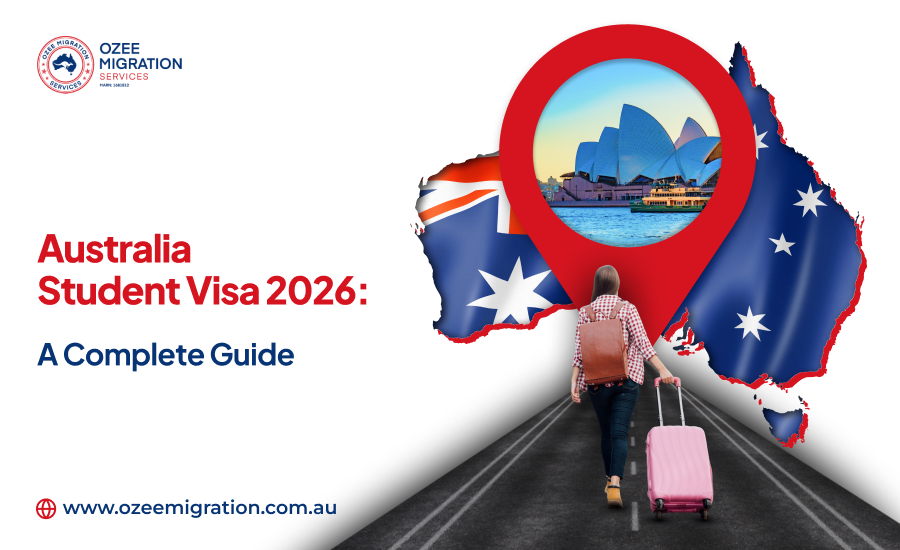
Every single year, countless students from around the world apply for an Australian Student Visa to pursue their academic aspirations.
Well, this is not surprising. Australia is home to some of the world’s most prestigious universities that offer globally recognised degrees and world-class education. Furthermore, after finishing their studies, students have access to high-paying job opportunities and a smooth path to permanent residency.
However, the regulations surrounding the Student Visa have become more structured and closely monitored this year. If you are considering studying in Australia, this guide provides complete insight into the Australia Student Visa 2026, including eligibility, the application process, and recent policy changes that applicants must be aware of.
Understanding the Australia Student Visa (Subclass 500)
The Student Visa (subclass 500) is an Australian visa programme for international students who wish to study full-time in Australia. This visa allows students to enrol in eligible full-time courses at any Australian educational institution registered with CRICOS, such as:
- English Language Courses (ELICOS)
- Vocational Education and Training (VET)
- Degrees from undergraduate and graduate programmes
- Programmes for research, including a PhD
The government allows eligible visa holders to work part-time for approximately 48 hours per fortnight on a subclass 500 visa. Students can, however, work as many hours as they want during scheduled course breaks. This work-hour limit is necessary for students to make ends meet without jeopardising their studies.
Students may accompany eligible family members (dependents such as Spouse or partner or Children) on the visa. Moreover, they are generally permitted to travel freely in and out of Australia as long as the visa is valid.
When it comes to how long the visa is active, well, it depends, basically, on the course you are pursuing.
Though! It can be extended further in many cases if the student wishes to continue their studies, change courses, or needs some more time to complete their programme.
Eligibility Criteria For an Australian Student Visa
What makes an individual actually eligible to get a student visa in Australia? For that, there are some of the key requirements as explained below:
Confirmation of Enrolment (CoE)
You must have a CoE issued by a CRICOS-registered institution. It should state the course name, duration, start date, CRICOS code, and other key details that verify your official acceptance and enrolment in a full-time course.
Genuine Student (GS) Requirement
You need to prove your genuineness for the visa that you wish to come to Australia with the main intention of studying, rather than migration or working. For that, you should demonstrate:
- What would be your academic and professional progression?
- Why did you specifically choose Australia to study?
- What are the connections to your home country?
- What are your upcoming career plans?
Financial Capacity
You must be completely transparent about your financial capacity, showing how you will pay your tuition, living expenses, and travel expenses during your stay in Australia. You can include bank statements, property valuations, fixed deposits, loan letters, sponsorship income, and other documents with your application.
According to the latest regulations, you must show approximately AUD 29,710 for one year’s living expenses. Furthermore, if you have dependants, you may be required to show additional funds.
English Language Proficiency
Unless otherwise specified, you must submit results from approved tests such as IELTS, PTE, or TOEFL. The minimum scores required vary depending on the course and the institution to which you are applying. Some courses may even require a higher level of English proficiency, so make sure you can meet this requirement.
Overseas Student Health Cover (OSHC)
OSHC is mandatory and must cover your full stay in Australia. It will help you pay for medical bills, prescription medicines, and even major medical emergencies.
Health and Character Checks
You must undergo medical examinations and provide police clearance certificates to prove good character for your eligibility for subclass 500.
Recent Update: What Has Changed for the Australian Student Visa In 2026?
According to a recent update, the Australian government will add 25,000 new student places in 2026.
This increase in the National Planning Level (NPL) is particularly purposed at better managing international student intake in the country while maintaining education quality and migration integrity.
In 2026, some groups will receive faster Australian Student Visa processing, including:
- Students from Pacific countries and Timor-Leste
- Scholarship holders
- Pathway students entering public universities or TAFEs
Besides, if the provider reaches its planned student limit, that doesn’t mean they process more applications. They can. However, these applications will be processed more slowly.
Brief Overview Of Key Changes for 2026
From November 2025, a new Ministerial Direction 115 (MD115) replaced the earlier framework and now governs student visa processing for 2026. Under this system:
- Student visa requirements remain unchanged
- Processing is prioritised based on institutional risk and allocation use
- Processing is typically faster for higher-trust providers.
- Applications from providers closer to their planning levels may have standard processing times.
Who Is Affected by These Changes?
These updates apply only to offshore Australia Student Visa applications, as follows:
- Applications submitted before November 14, 2025, are processed under the older framework.
- Applications submitted on or after November 14, 2025, are processed under the new MD115 system.
Student Visa Application Process (Step-by-Step)
Here is the entire simplified process you need to follow when applying for Subclass 500:
- Choose a course from a CRICOS-approved institution.
- Get an offer letter and pay the initial deposit to receive your CoE.
- Apply for an approved English language test, score well, and receive a certificate.
- Undergo medical checks and police clearance as well (if necessary).
- Gather your required documents, such as bank statements, education loan letters, sponsor documents, scholarship proof, etc.
- Prepare a strong GS Statement outlining the necessary details.
- Purchase an OSHC valid for your stay in Australia.
- To submit your visa application, go to the Department of Home Affairs website and set up an ImmiAccount.
- Wait for approval and keep track of your application online. Make sure to promptly provide any additional information requested by the Department.
Final Thoughts
As of 2026, the Australian Student Visa process is more structured and closely monitored than ever. However, with the right preparation, complete documentation, and a strong Genuine Student Statement, you can secure your visa.
To help you with this, Ozee migration can provide you with professional immigration assistance with your visa application. Our registered MARA agents can help you navigate the various study opportunities in Australia, obtain the CoE, establish genuine academic intent, develop strong financial documentation, and complete the Subclass 500 visa application process. Get in touch with us to know how we can improve your chances of visa approval.
Recommend Read: What Are the Work Limitations for International Students in Australia?
Recent Posts
 Top 10 Benefits of Permanent Residency (PR) in AustraliaAugust 12, 2026
 What Is the Processing Time for the Skills in Demand Visa (Subclass 482)?August 6, 2026
 Australia Visa Fee Increase from 1 July 2026: Complete GuideJuly 30, 2026
 What Are the New Skilled Visa Income Thresholds in Australia for 2026?July 23, 2026
 What Are the Requirements for the Skilled Employer-Sponsored Regional (Subclass 494) Visa?July 16, 2026