
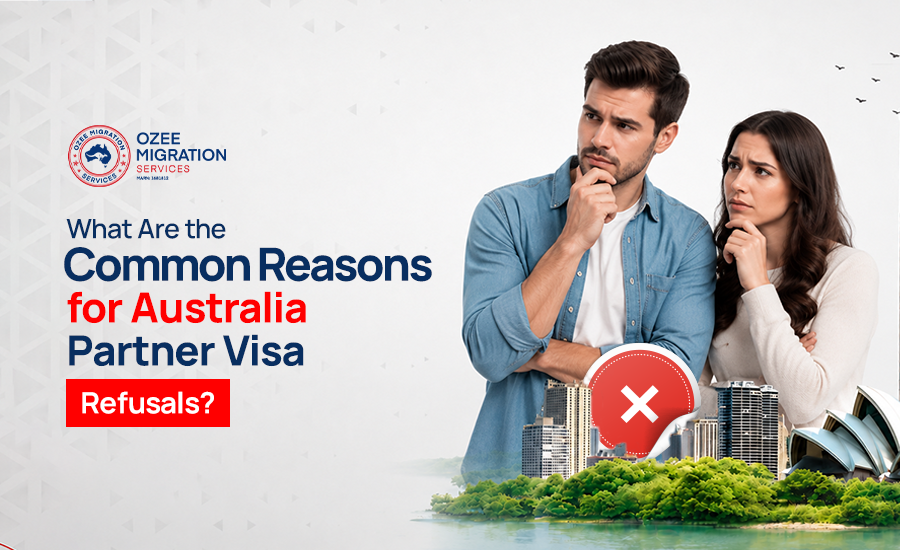
The Australian government allows spouses and even de facto partners of Australian citizens, permanent residents, or eligible New Zealand citizens to apply for partner visas. You can apply either through onshore Subclasses 820/801 or offshore Subclasses 309/100 pathways to join your partner and build your life together in Australia.
But in contrast to most applicants’ beliefs, being married to or in a relationship with an eligible sponsor is just not enough. You need to meet different eligibility criteria depending on the specific partner visa you are applying for and attach detailed documentation for the same.
The Department of Home Affairs thoroughly reviews each application and can reject it if they spot any errors that jeopardise its credibility. Read this blog to learn the common reasons for refusal in the Partner visa program to help you prepare a stronger application.
Most Common Reasons for Australia Partner Visa Refusals
While the Australian immigration authorities evaluate partner visa applications based on their individual circumstances, the reasons for refusal can vary from one application to another. However, some issues are more common than others. Here are some of the most common reasons why an Australia Partner Visa may be refused:
1. Insufficient Evidence for Genuineness of Relationship
Lacking evidence to prove the relationship is genuine and continuing is the most common reason for visa refusal. The Department of Home Affairs would require more than just your marriage certificate to decide whether you are a genuine applicant.
The department expects complete evidence covering areas such as finances, household arrangements, social recognition and long-term commitment to prove a marriage and a de facto relationship.
Hence, you need to file each and every document that proves these areas of a real relationship or marriage. Furthermore, prioritise documentation quality over submitting hundreds of irrelevant documents.
2. Inconsistent Information in the Application
Inconsistencies in a partner visa application have proven to be a major issue in visa approval. Any inconsistency in the submitted details can actually impact the credibility of your whole application.
The department examines consistency in areas such as the couple’s first meeting, when the relationship began, when the couple began living together, previous addresses, marriage dates, travel history, previous relationships, and more.
Minor differences are natural, as one cannot remember even a single date, especially for events from several years ago. Nonetheless, significant or unexplained inconsistencies may call into question the credibility of your evidence and the sincerity of your relationship.
3. Past Visa Breaches
If you violated the conditions of your previous visa, it will have an impact on your partner visa application. The department will look into your previous immigration concerns and may decline your application.
The decision will be based on the nature and circumstances of the breach. Moreover, a previous breach does not necessarily mean your partner visa will be refused. Still, serious or repeated breaches can raise concerns and could affect your eligibility.
4. Health Requirement Issues
You’ll need to meet Australia’s health requirements to be eligible for a partner visa. And for that, you need to go through all the health examinations as requested by the Department and get clearance that you are in good health. However! Health problems do not typically result in a refusal of a partner visa.
The department may request further medical examinations or further health information. So, you need to provide complete and accurate information to avoid unnecessary delay.
5. Character or Police-Certificate Problems
Character requirements are another important part of the Partner Visa process. You would have to file police certificates for countries where you have spent a specified amount of time over the years.
You have to honestly disclose any criminal charges and convictions. Even if the behaviour occurred years ago, the visa may still be denied based on how serious it was.
6. Limited Evidence of Living Together
Couples who claim to have lived together must provide proof of shared living arrangements. The department would look at how household responsibilities are handled and whether the couple truly functions as a household.
You would need to attach documents such as utility bills, mail addressed to both partners, joint household purchases, and so on. This is essentially critical if you are a de facto applicant.
This can also help in proving you had a minimum 12-month relationship period immediately before applying. Failure to do so may result in refusal.
7. Sponsor-Related Problems
The person who is sponsoring the applicant needs to be qualified as well. In general, the sponsor must be a citizen of Australia, a permanent resident of Australia, or a citizen of New Zealand.
Besides this, they cannot sponsor more than one partner in the last 5-year span. Hence, issues relating to the sponsor’s previous sponsorships or the base sponsor’s eligibility may affect the application.
8. Incomplete Partner Visa Application
That’s pretty obvious: your visa application will be denied if you don’t submit it with complete information. You need to provide all the documents and fill in each and every single detail demanded.
In case of missing documents, incomplete relationship evidence, missing police certificates, or incorrect forms, the department can delay the visa processing and demand additional information. And, if you fail to provide the requested additional information, it may result in visa refusal.
9. Previous Relationships Not Properly Disclosed
You might need to provide complete information about previous marriages or de facto relationships, if any. You may be required to provide divorce certificates, death certificates, separation documents or statutory declarations, among other things. If you hide or misrepresent previous relationships, your visa may be denied or cancelled.
Final Thoughts
The Australian Department of Home Affairs is extremely strict when it comes to evaluating partner visa applications. Even if you and your partner are genuinely in a relationship and envision a long-term future together in Australia, your application may be rejected if it fails to actually prove this. Hence, you need to meet all the eligibility requirements and provide clear, consistent and authentic evidence to build a strong partner visa application.
Do you need assistance with your Australian partner visa? Ozee Migration is here to help!
Whether you’re applying for an onshore or offshore partner visa, our registered migration agents can help you understand the process and fill out a complete application with accurate relationship documentation. We will make sure you avoid common documentation and eligibility mistakes in your visa application. Contact Ozee Migration for personalised Australian migration guidance!
Recommend Read: Top 10 Benefits of Permanent Residency (PR) in Australia
Recent Posts
 Can You Switch From a Tourist Visa to a Partner Visa in Australia?October 22, 2026
 Australia Student Visa Changes from October 2026: New Rules ExplainedOctober 15, 2026
 How Does the Subclass 186 Visa Provide a Path to Permanent Residency?October 7, 2026
 How to Apply for a Subclass 491 Visa in Australia: Step-by-Step GuideSeptember 29, 2026
 Australia Migration Changes 2026: New Visa Rules and Key UpdatesSeptember 18, 2026